The logic behind industrial investments has changed significantly in recent years. In the past, replacing an aging system with a new machine was often an automatic decision. Today, however, rising energy costs, high investment expenses, and the risk of production downtime force companies to evaluate much more carefully whether a complete replacement is truly necessary.

An older production line may still operate reliably today. Production is running, the machine is not constantly stopping, and the system still “does its job.” At the same time, however, hidden losses may appear every single day — losses that can become major long-term costs for the plant.
Industrial companies are therefore no longer simply modernizing machines.
They are optimizing business risk.
The logic behind industrial investments has changed significantly in recent years. In the past, replacing an aging system with a new machine was often an automatic decision. Today, however, rising energy costs, high investment expenses, and the risk of production downtime force companies to evaluate much more carefully whether a complete replacement is truly necessary.
In many cases, the machine itself has not become unusable — the surrounding technology has simply become outdated.
This is why industrial retrofitting has become one of the most important modernization strategies in recent years.

For a long time, retrofit projects were viewed as simple “facelifts” in industry. Today, however, the concept is far more complex.
A modern retrofit project is no longer just about keeping a machine operational. The real objectives are:
Most modernization projects today are designed to address three critical issues.
The first is energy consumption. Many older systems still operate with oversized motors, outdated drives, or inefficient control strategies. In certain applications, introducing modern variable frequency drives or servo systems can reduce energy consumption by as much as 20–40%.
The second issue is spare parts availability. Many factories still rely on PLCs and drives for which spare parts and technical expertise are increasingly difficult to obtain. In such cases, retrofit is no longer a matter of convenience — it becomes an operational reliability necessity.
The third factor is availability. In modern manufacturing environments, the most expensive asset is often not the machine itself, but the downtime.
One of the biggest problems in industrial modernization is that companies often begin considering retrofit only when the system has already become critical.
Typical situations:
At this stage, retrofit projects are no longer strategic developments — they become forced solutions.
The most successful retrofit projects usually begin much earlier: before the system turns into an operational risk.
Industrial companies today are far more cautious with large capital investments than they were a few years ago.
Purchasing a completely new production line involves far more than the machine price itself. Additional costs include:
By comparison, retrofit projects can often be implemented gradually. A drive modernization or PLC upgrade can frequently be integrated into scheduled maintenance shutdowns, significantly reducing production risk.
This is particularly important in industries where availability is critical.
In automotive, food processing, or continuous manufacturing environments, even a few days of downtime can result in substantial financial losses.
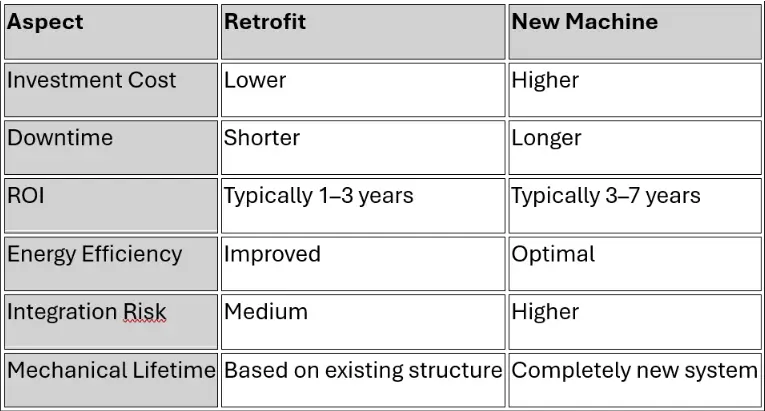
Another major advantage of retrofit is faster return on investment. While a new machine may require 5–7 years to pay back, a well-prepared retrofit project can often achieve ROI within 1–3 years.
In today’s economic environment, this can become a decisive factor.
Many industrial facilities still operate first-generation variable frequency drives in fan or pump systems. These systems often run at fixed speed, even though the process itself does not require constant output.
In such cases, a modern drive upgrade can:
In many applications, this type of modernization alone can pay for itself within just a few years.
This is why drive modernization has become one of the most common retrofit strategies in industrial automation.

Retrofit is not a universal solution.
There are situations where modernization only postpones the problem temporarily.
This usually happens when the mechanical foundation itself becomes outdated. If a system is mechanically inaccurate, heavily worn, or technologically limited, even the most advanced control system or drive technology will not allow the machine to meet modern production expectations.
This is where many companies make a critical mistake.
They try to keep aging systems alive for too long, even though the real issue is no longer automation — it is the mechanical condition of the machine itself.
Modernization at this stage becomes increasingly expensive while reliability no longer improves significantly. This is the point where a new investment may become the more economical long-term decision.
Industrial companies today evaluate much more than investment cost alone.
Decision-making increasingly focuses on:

Most failed retrofit projects do not fail because of technology.
They fail because of planning.
One of the most common mistakes is focusing on replacing only a single component. Companies upgrade the PLC or the drive system while leaving the communication infrastructure, sensors, or mechanical system untouched.
The result is often unstable operation and difficult-to-diagnose failures.
Undersizing is another common issue. Many retrofit projects focus too heavily on minimizing initial investment costs without properly analyzing the full load profile. Undersized drives can lead to overheating, reliability problems, and reduced service life.
The most dangerous mistake, however, is usually overly optimistic ROI calculations. Companies often calculate payback based only on energy savings while overlooking integration time, commissioning costs, or production downtime risks.
Successful retrofit projects therefore begin with system optimization — not simple component replacement.
The logic of industrial investment decisions has changed significantly in recent years. Previously, many companies focused primarily on CAPEX: how much a new machine or retrofit project would cost.
Today, however, much greater emphasis is placed on the total lifecycle. Companies now evaluate not only investment cost, but also:
This is why the right decision is increasingly not complete machine replacement, but well-targeted modernization.
The most successful manufacturers no longer make decisions based on habit. They analyze:
Retrofit is therefore no longer about extending the past — it has become a strategic tool for more competitive, energy-efficient, and sustainable industrial operation.
Sources
A detailed system assessment can quickly reveal where the plant loses the most in terms of energy efficiency, availability, or maintenance costs.
In many cases, targeted:
The question is no longer what can be replaced.
The real question is where modernization delivers the fastest business impact.
The world’s steepest aerial tramway, the Swiss Schilthornbahn project, is not only a tourist attraction but also a serious industrial and engineering challenge. The slope of more than 159%, alpine weather conditions, and strict safety requirements made it clear already in the planning phase that this was a task that could not be solved with standard solutions.
Industrial electrification is no longer a future concept but a defining factor of today’s industry. Companies that invest in efficient, electrified systems now are not only optimizing performance and sustainability, but also securing a clear competitive advantage for the near future.
Industrial energy consumption often doesn't disappear where most people look for it. Oversized systems, poorly optimized motion profiles, and "invisible" operating processes can account for a significant share of unnecessary energy costs. In this article, we explore where hidden losses occur and how a system-level approach can unlock meaningful efficiency gains.
The selection of pneumatic valves is often treated as a secondary consideration, even though it has a critical impact on overall system performance. In this article, we highlight the three most common mistakes that lead to slow operation, inaccurate performance, and unnecessary energy consumption. If you work with pneumatic systems, this is worth reading.